
Where We Overlap
Where We Overlap is a participatory project that combines an immersive video installation with a sensory play space for families. Adults and children are invited to explore and create together within a world of light projections and loose parts.

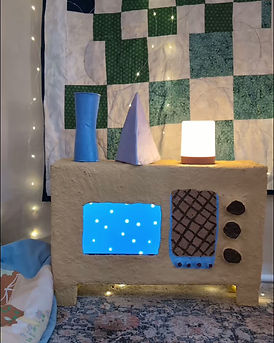
Video Installation
My animations illustrate moments of shared wonder and discovery between a parent and child. Within dreamlike landscapes, figures are revealed and transformed by cycles of nature.
Inside Where We Overlap, the animations are exhibited as large projections on the walls, and also on small screens within intimate spaces. Children can experience the artwork up close inside a tent or a dollhouse, or as an immersive backdrop while they explore the full gallery.
Many early years spaces prioritise entertainment or development for children, while overlooking the creative and intellectual inner life of parents. This project is designed to support both. The video installation speaks to the emotional landscapes of caretaking, with scenes illustrating moments of attachment, separation, wonder, anxiety, curiosity, exhaustion, and love.

Loose Parts Play
Loose parts play centers on open-ended materials that can be engaged in countless imaginative ways. Within the play space participants will encounter a field of objects, some recalling motifs from the animations and others entirely abstract. The pieces and parts invite building, moving, balancing, problem-solving and collaborating. The animations expand these possibilities further, offering visual fragments that can be echoed and extended through storytelling with loose parts.


Model
This project draws on my professional experience leading the Make Play project at Modern Art Oxford, which is grounded in a Reggio Emilia approach, and my background as an art teacher in a Montessori school. Both philosophies recognise the child as naturally self-directed and curious, and describe the environment as an active participant in creative learning. I believe that adult creativity can be nourished with the same ethos, within an environment that grants permission to play and reconnect with one's own inner child.


Where We Overlap, 2026
pilot pop-up at The Source in Oxford, UK